When most students call it a night, junior Aidyn Luttrell is planning out the perfect night. Using his telescope and camera, he spends his evenings gazing upward, capturing plants and stars that many only see in textbooks.
“It’s a very situational hobby, because it does rely on a lot of outside factors,” Luttrell said. “There’s got to be a clear night, it’s got to be good weather and you have to know what you’re looking for.”
Luttrell’s interest in space began when he was a child.
“My grandma gave me this book of all the planets and for a month, I would just spend all my time rereading it,” Luttrell said.
That early fascination eventually developed into a passion for astronomy and astrophotography.
For Luttrell, the right night to take a photo is rare.
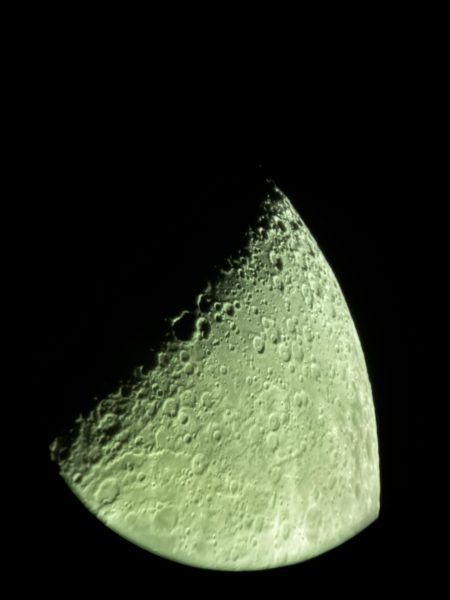
“The perfect night would be one where the weather is warm, preferably during the fall, because that’s when you are able to see more stars and stuff in the sky,” Luttrell said. “Obviously, less light pollution, but here in Nixa that’s kind of hard to find unless you live out in the countryside.”
He said that even the moon can interfere with visibility.
“You have to make sure that either the moon isn’t out that night, or if it is, that it’s a new moon,” Luttrell said.
For him, those rare moments provide more than just a photo opportunity.
“You kind of get this sudden sense that what you’re looking at is real,” Luttrell said. “It kind of makes you feel existential for a second. It’s like, holy, this is huge. It’s far away from me and I’m never going to see it in my life, but I’m looking at it. And that’s the cool part.”
Luttrell said his fascination with space has shaped his career goals.
“I want to become more interested and fascinated by all the stuff in space,” Luttrell said. “So when eventually I go and hopefully work at a place where they study space, I know what I’m doing and I can enjoy it.”
As the Space Marines enter the battlefield, an alien hive mind known as the Tyranids, who are fixated on assimilating as many planets as possible, swarm in the skies above and the ground below, prepared to rip them to shreds. In the world of “Warhammer: 40,000,” a tabletop game, book series, video game series, and collectible, this is the grim scenario of one of the most popular factions among players: the Ultramarines.
While the Ultramarine-Tyranid conflict is the poster child of “Warhammer: 40,000,” there are dozens of intricate and interconnected factions in this story. From orcs to daemons and robots alike, “Warhammer: 40,000” has a variety of factions that players of all kinds.
Junior Geoffery VanHorn became invested in the world of “Warhammer: 40,000” a year ago through his dad and brother.
“I first actually heard my dad talking about it, and then my brother started geeking out about it,” VanHorn said. “I was like, ‘Oh, let me look at this,’ and I just watched all these videos like, ‘Oh, that would be cool to have-oh, this is how you play that.’ We started [with] a kill-team of Necrons versus Space Marines, and we started playing that. We built that together.”
VanHorn plays the Grey Knights, the 666th chapter, or division, of the Space Marines, who specialize in hunting forces of chaos and daemons. They were created in response to the failure of a project the emperor started, which ended in the opening of a rift where daemons began to flood into the galaxy.
“[The Grey Knights] were just a secret thing to build up against the forces of chaos … And then the Horus Heresy (mass betrayal of the emperor) happened, and they got … lost in a warp storm until [year] 40k, and they came back [as] a bunch of Grey Knights.”
While “Warhammer: 40,000” is a very diverse and flexible experience, one downside is that the game only works for people who can make a commitment to a faction due to the high price and time that Warhammer demands.
“[I recommend this to] people with time and, if you’re able to … save up some money and … you’re fine with not having everything, because you’re gonna have to make a commitment to one thing, because they are very expensive. You have to make a commitment to one army.”
It’s a bird, it’s a plane, it’s senior Julian Humphrey; beginning his hobby and future career as a pilot in seventh grade, Humphrey has amassed around five hours in the cockpit. So far, the captain-in-training has flown both a Piper Archer III and a Cessna 747, and will continue to grow his experience in the field of aviation.
“My uncle is a pilot – he first introduced me to the idea of being a pilot,” Humphrey said. “This is something that for a long time I’ve wanted to do as a career … I currently have five-ish hours in the sky built up.”
To many, the very idea of being more than 50 feet above the ground can be a gut-wrenching thought, let alone the 10,000 to 35,000 feet that many planes soar at. Humphrey’s first flight took place at the Springfield airport along with two other students.
“The most interesting thing was we did a 360-degree turn,” Humphrey said. “The instructor did it first, and then he had me do it, and so what was going through my mind was, obviously, panic and fear, but also the enjoyment of just being able to do this by myself for the first time.”
While flying a plane is a large part of being a pilot, they must also learn to check the health and readiness of their plane before they can take off.
“Whenever you’re on the ground, you’re doing all the different types of checks on the plane,” Humphrey said. “So you’re making sure that all the lights work, the landing gear works, and you have enough gas, enough oil and all that. And that’s definitely hands-on. And then whenever we’re actually in, I’m the one flying the plane, and if there’s corrections needed, then the instructor makes the corrections. But I would say taking off and landing, those were completely the instructor, because they’re the most risky parts.”
While becoming a pilot is considered an amazing achievement by most, it is a hobby that almost anyone can get into with the right resources.
“I don’t think it would be everyone’s first pick,” Humphrey said. “Especially people who are scared of heights or have a fear of flying in planes. But I do think it’s a hobby that anyone can get themselves into, especially if they have like extra time.”