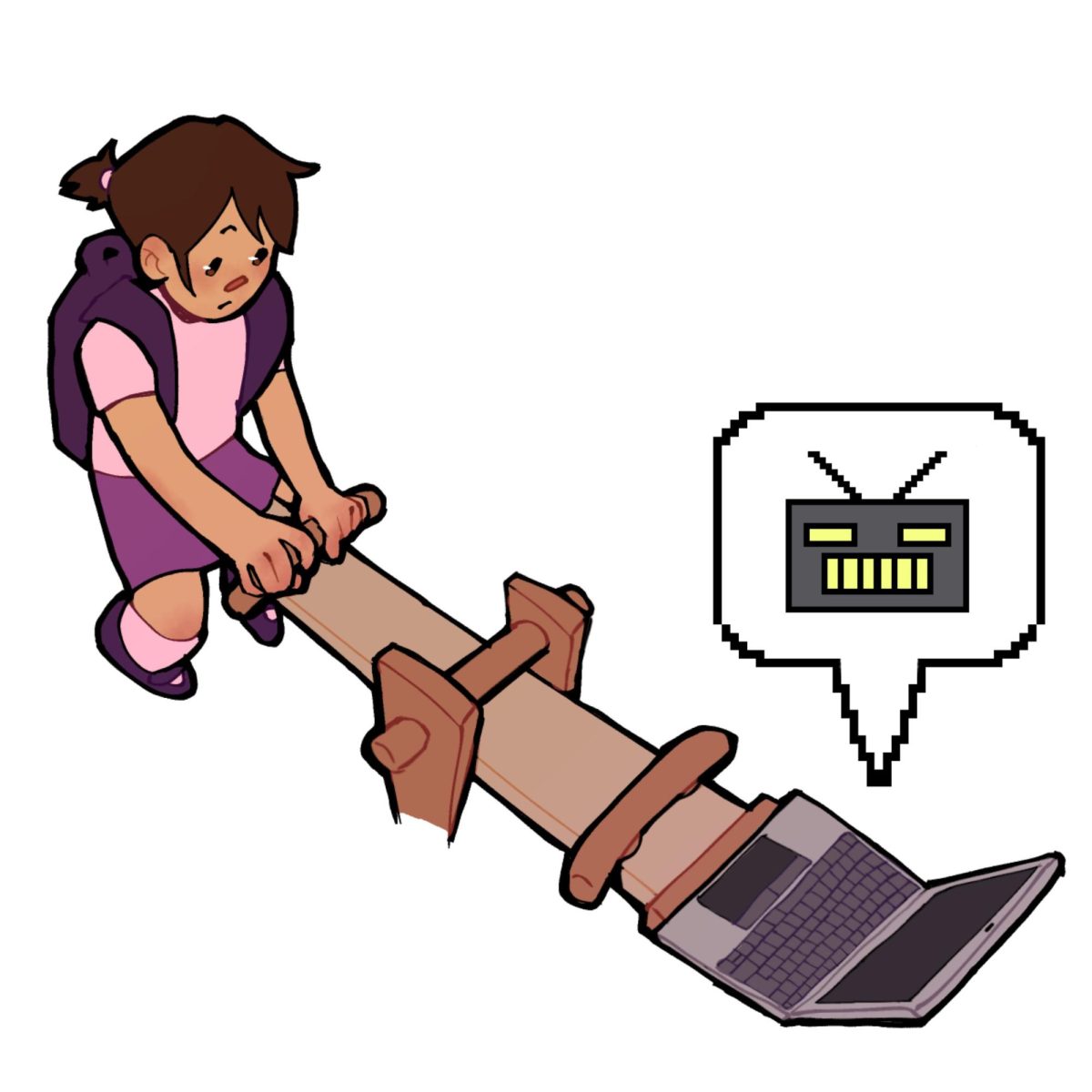
The market for Artificial Intelligence in education has reached $7.57 billion, and 60 percent of teachers have incorporated AI into their regular teaching routines, according to Engageli.com. When it comes to education, the impact AI has had and could have is undeniable in both good and bad ways.
As reported by the National Library of Medicine, one of the most beneficial aspects of AI in education is its ability to tailor education to a student’s individual needs.
“AI is already revolutionizing education because it has to be considered as part of the planning and instructional process,” secondary curriculum specialist Melissa Villanueva said. “Whether we like it or not, AI is changing the nature of the information we receive and consume, and it is becoming a part of our everyday lives. It could prove to be a valuable tool in many ways, but we also have to be careful that we approach its use critically and think about whether or how it aligns with our purposes.”
As long as AI doesn’t begin to replace critical thinking, its uses can be applied as a tool in many aspects of life.
“In trying to buy a house and keeping track of all of the costs and the percentages and all of that, I would use ChatGPT to say, ‘Hey, help me know what I need to pay,’ but at that point, it’s only an adviser,” English teacher Jon Spence said. “It’s additional to all of these relationships I’m having with my realtor … or my insurance broker. It should not become the thing that teaches me.”
Keeping AI as an adviser instead of a replacement for human thinking is essential to the prosperity of all aspects of life, and failure to do so would put creativity, education, and reasoning at risk.
“An over-reliance on [AI] would also, in my mind, be to say, ‘Here, machine, do this thing that I could learn how to do and develop my own style and develop my own artistry to,’ and just giving it over because there isn’t enough time … or I don’t want to take the effort with regard to critical thinking,” Spence said.
According to Engageli.com, 89 percent of students have used AI to help with their homework, which can be seen as a tool, like a calculator, or a method of cheating, similar to students trading answers.
We have to be really intentional about how we use AI. I think one of the ways we do that is by, as teachers, modeling ethical AI use,” Villanueva said. “Like we have rules of the road and guardrails in place to keep everyone safe while driving, I think we also need to have clear rules and guardrails in place for AI use, especially when it involves student use.”
The widespread use of AI among students also has the potential to negatively affect the social life of not just students but society.
“I think that we need to talk to each other as teachers and see where it’s being used,” Lechner said. “We have to be very cautious of – number one, not knowing what the future looks like. Number two, we have to teach students about being people … that’s a very important part of what we do here, is teaching people how to interact with each other, teaching people how to have compassion and empathy for each other, and the AI can take a lot of that out of the game.”
AI’s impact on the social aspect of human health is not limited to education; in addition to AI chatbots, which some may use to replace real human contact, AI has also begun replacing people in the workforce.
“I think that there’s a lot of places that we already are taking people out of the workplace that we need to remember to keep them in, because people need interactions with each other,” Lechner said. “I know that I can’t be the only one frustrated when we go somewhere to buy something … and now we are just told to check it out ourselves and leave. So [AI] is going to eliminate a lot of society from actually talking to people at all.”
In many cases, critical thinking and creativity go hand in hand, and AI poses a threat to both aspects that have made humanity thrive.
“Creativity is definitely at risk, because it’s just so much easier to throw it into the computer and to come out like with a product that could be creative,” Lechner said. “We definitely risk allowing students the chance in school to experiment with their own creativity, to develop their own voice in writing, because high school is really the age that they start to learn to do that.”
In addition to potentially stunting creativity, AI may also devalue what humanity has already created, as human works largely influence its output.
“I teach a subject that’s extremely creative in its nature, and … my concern is that what the [AI] is pulling from are already written novels and published work,” Spence said. “It’s just adopting that human creative capability … it would be taking away content that people have already taken the effort and the time to create.”
In addition to the potential for AI to take away the significance of time and effort for artists, it may also have a similar effect on students’ schoolwork.
“If I was a student and I gave my work in and [teachers] graded it with AI, and I could tell, I would feel a little bit insulted.” Spence said. “I can’t necessarily speak for every subject, but I think on principle, for me … if I’m telling my students they can’t use AI and they need to be showing their work … then I should in response and in good faith, honor the work that they’ve done by evaluating it myself.”
With so many assignments to grade, however, teachers may not be able to keep up with their lessons in a timely way, but if AI is used as an assistant rather than a replacement, it can still be a useful tool.
“AI could be used as a tool to provide feedback, but the teacher needs to review and revise that feedback to make it as accurate and useful as possible,” Villanueva said. “However, AI should never replace the teacher in the grading process nor should it be used to issue grades.”
The idea of a robot doing all the work may be a tempting idea for both teachers and students, but the price of that leniency may be everything humanity has built to prosper.
“Humans, throughout time, have written stories, have made art, have developed theorems and calculations and have discovered our world,” Spence said. “So I am highly suspicious of the thought that we should give over all of that, just to simply have more time- more time to do what? More time to be entertained, more time to sit and watch TV? What are we wanting to have more time to do? It makes things faster, yes, but what are we losing for the benefit of gaining time?”