When Missouri lawmakers passed House Bill 12, they approved giving $50 million in tax dollars to MOscholars, which will offer public money to pay for private education.
MOscholars is a program that provides Empowerment Scholarship Accounts (ESA) to families in the form of a tax credit, allowing them the resources to choose their children’s schooling. This change in funding came about as part of the school choice movement. This legislation passed a few months before June, when Gov. Mike Kehoe vetoed $300 million in state education spending from his January budget proposal, including $14 million for higher education and $2.5 million for teacher recruitment.
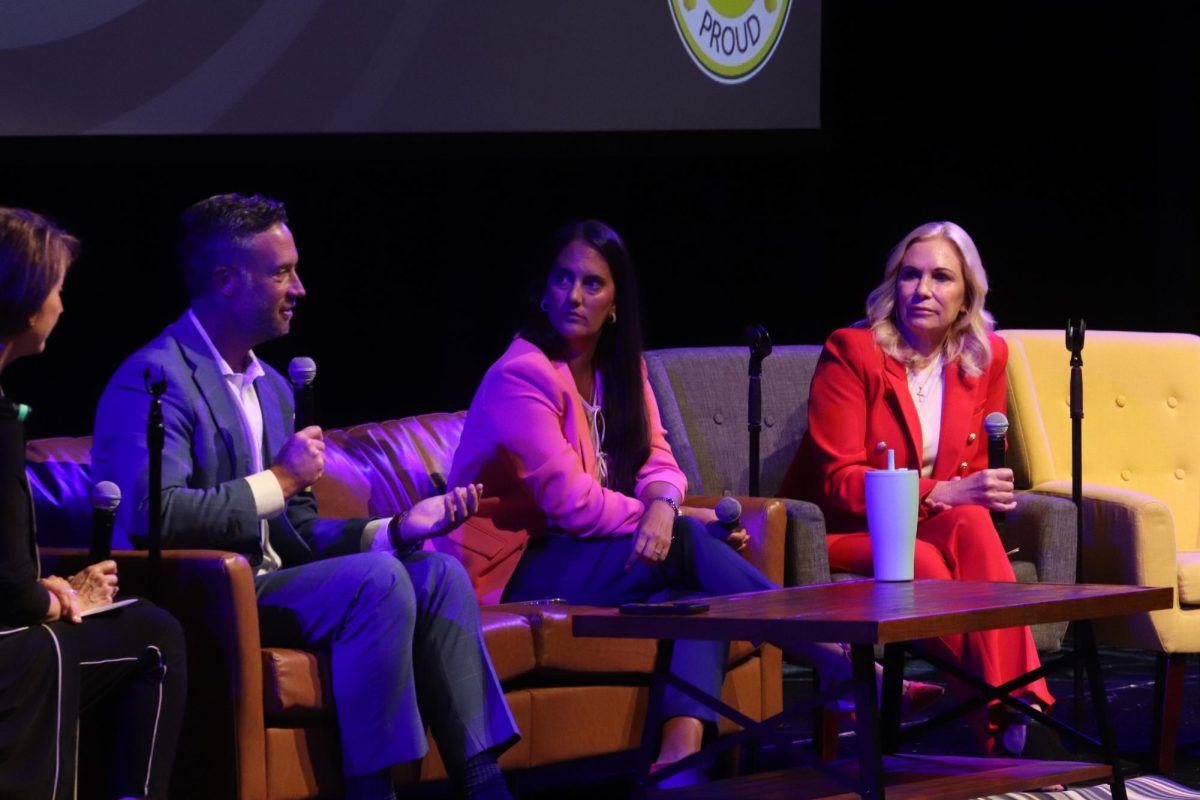
Some Missouri lawmakers have spoken out against the funding changes. The Greater Ozarks Cooperating School Districts, a program designed to promote collaborative professional learning in K-12 schools across Southwest Missouri, hosted Missouri lawmakers at the AETOS center on Oct. 1 to discuss HB 12.
With private schools now able to receive state tax money, HB 12, which was passed in June, allows them to maintain their current admission practices, even if the admission practices violate anti-discrimination laws.
“I have a lot of concern about … our tax dollars going to private schools that don’t educate all kids, or that are faith-based, that discriminate based on race, sex, sexual orientation [and] that make you sign a pledge saying your family believes in certain things,” Missouri House of Representatives member Betsy Fogle said. “That is not public education, that’s not where public dollars should be spent.”
Critics of the funding changes say that giving public funding for the private school scholarship program was unconstitutional.
Fogle said the $50 million will go to private school tuition as a voucher.
“Those vouchers are about $6,000 to $7,000, but what we know for a lot of private schools here in Springfield, the cost of tuition at that school might be $15,000,” Fogle said. “What the majority party will say is that these vouchers are going to lift families out of poverty, get them out of bad schools and put them into good schools. I completely disagree with that.”
At Springfield Catholic, a K-12 private school, starting tuition ranges from $5,000 to $10,500 per student, depending on grade level.
Missouri State Senator Lincoln Hough said the bill was signed off because it fully funded Missouri’s ‘foundation formula,’ a funding method to determine how much aid a school district receives. A criterion is used to evaluate funding for school districts, including attendance, local taxes and how much funding each student needs for a basic education.
For the 2025-2026 school year, the foundation increased funding from $3.4 billion to $3.7 billion. The $300 million increase comes in April after the Missouri Senate included it in their budget plans, going against Gov. Kehoe’s earlier wishes.
“As long as the foundation formula is fully funded, it doesn’t hurt public schools,” Hough said. “This is the first time last year that we spent general revenue on private or parochial charter school vouchers.”
Fogle said one of the reasons why parents are typically apprehensive about letting their children attend public schools is a lack of transparency with the information given. This has contributed to the rise of school choice.
“Transparency is key,” Fogle said. “A lot of what I hear as an elected [official] from people who are hesitant or apprehensive about public schools is that they don’t feel like there’s transparency. Again, highlighting SPS [Springfield Public Schools], I think they’ve been very intentional about building out opportunities for families and the public to come in and see what they’re doing.”
Fogle said one of the Missouri General Assembly’s top priorities is education.
“We pass budget bills in a specific order,” Fogle said. “Number one: public debt, which … we no longer have any. Number two is education. It is the most important thing that we do as a general assembly. So if your elected officials are not willing to come to your schools and see what’s working and what’s not working, then I would choose a different elected official.”
Throughout Missouri, some school choice programs are implemented to provide high school students and young adults with training for specific fields. The Alliance for Healthcare Education is a collaborative project from Ozark Technical Community College, Missouri State University and SPS to create a pipeline for future healthcare workers, but is also a school choice program.
“When we talk about starting kids young, exposing them so they know what they want to do, by having the Alliance program in place, this allows the pathway in for our students immediately into good-paying jobs and they can take whatever track they need,” Missouri State Board of Education President Mary Schrag said.
Fogle, a Parkview High School graduate, said school choice programs can allow students to explore passions that couldn’t be provided previously.
“We [Parkview] didn’t have an agricultural school, we didn’t have an aviation program,” Fogle said. “I think those opportunities for students are invaluable, and I look forward to seeing what they do in the future to expand those opportunities for all students.”
Hough said that funding education, whether for public or private schools, will overall have a net positive for Missouri.
“The best way for Missouri to prosper and the best way for our workforce to be trained for the next generation is to invest in the educational opportunities that those kids are in front of,” Hough said. “When it makes sense to put money behind the programs that educate the kids for the future, that’s what we [state government] do.”