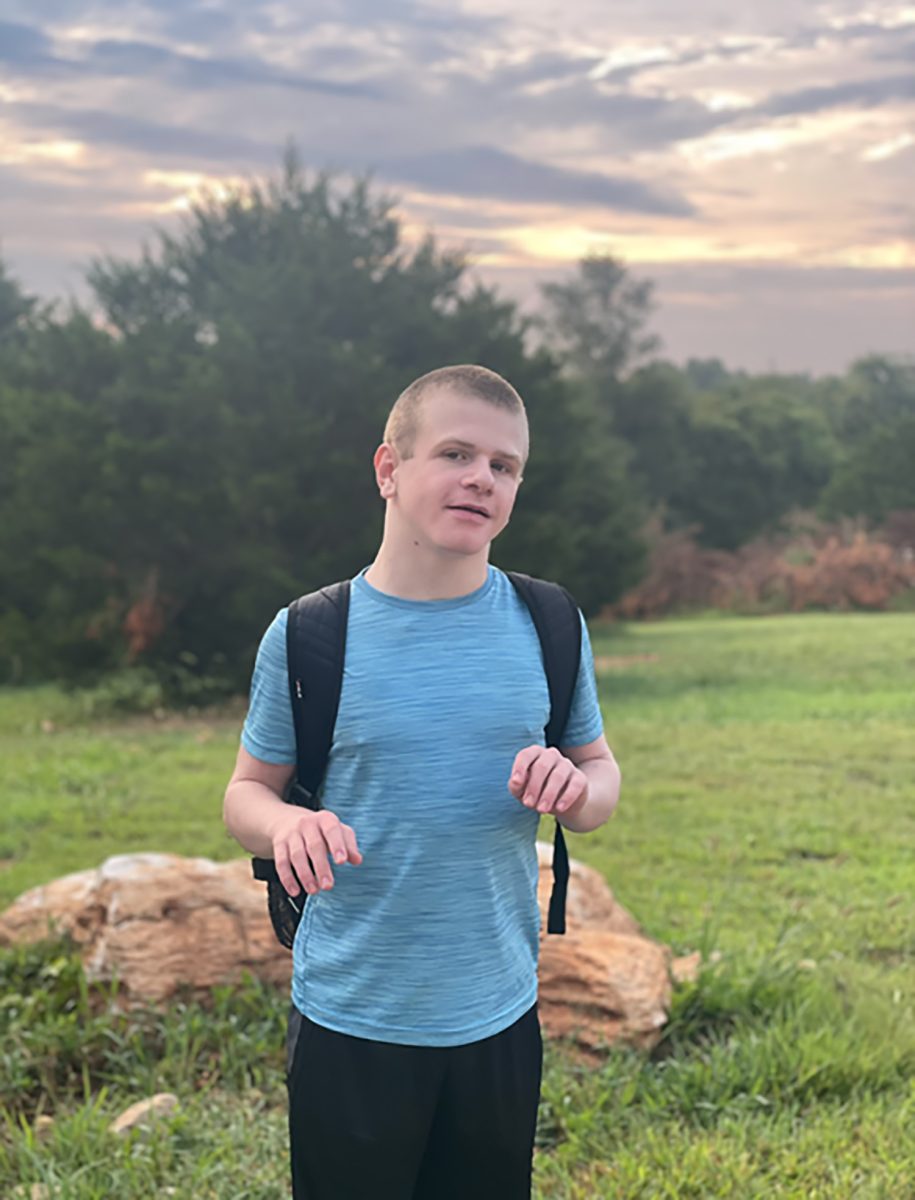
Even now, Noah Burrow’s desk is still there.
“He’s not here in our classes now, but he’s still here, and he’s still very present [in] our classrooms and in the way we teach,” Alician Humes, Noah Burrow’s life skills teacher, said.
Noah Burrow was a senior at Nixa High School and he had non-verbal autism. He died on Dec. 6, 2025, at the age of 17.
His mother, Jena Burrow, called him a “fighter.”
“He faced many struggles [and] challenges with life every day, however he would still have many smiles come through,” Jena Burrow said. “He was a bright light that taught us many things.”
In the classroom, Humes said Noah Burrow “loved to entertain,” and often pulled pranks. Humes’s favorite prank came while he was practicing spelling with a paraprofessional using Bananagrams tiles. When the para wasn’t looking, he’d slip the tiles into his pocket. Once they ran out of tiles, he would quietly return them to the table, when the para wasn’t looking.
But on the bus, Noah Burrow showed a different side. Linda Riggs, his bus aide during his junior year on bus 35, said he never pulled pranks on her or her husband, Randy Riggs, who drove the bus.
“He was always just happy,” Linda Riggs said. “He liked the bus ride, and he sat right behind Randy, the bus driver, and he’d take that blanket, and he would rub his face to where it was almost chapped with that blanket.”
Linda Riggs said she noticed Noah Burrow didn’t have anything to do with his hands, so she got him a camouflage blanket, which became a part of his bus routine.
“[The blanket] that was his life support,” Linda Riggs said. “The first thing he got when he got on the bus was that blanket, and it was his security.”
Pam Totten, another bus aide who worked with Noah Burrow, said he communicated through gestures and expressions.
“He was extremely expressive,” Totten said. “You knew just by his actions what he wanted.”
Totten said his communication was visible in small, everyday moments. If he wasn’t feeling well, it showed in how he moved. When he wanted something, he made it clear — especially with food.
“In the afternoon he wanted his food … and it was just kind of this running joke when he would see me, he’d want his food knowing that I couldn’t give it to him because I didn’t have any,” Totten said.
Even without speaking, Totten said, Noah Burrow understood what was happening around him and responded in his own way. Those daily interactions showed how much he was learning and growing.
“The first year that we had Noah, he was in a lot of pain,” Humes said. “After that, when he was feeling better, you could see his funny personality come out, and his willingness to communicate with us. We saw his communication grow almost exponentially after he was physically feeling better.”
Noah Burrow’s presence has left a lasting mark on the people around him and future Nixa students. His vocational skills teacher, Aubrey Hardy, said watching him engaging with the world helped her better understand and connect with her students.
Noah Burrow’s desk remains in his old classroom, a reminder of his impact on the environment around him.
“As a team, all of the paras that worked with him, decided to keep it [his desk] up just as it would be,” Humes said. “If it was down, it would be more noticeable that he wasn’t here anymore.”